According to TxDOT's 2025 Texas crash facts, 559 motorcyclists, including passengers, were killed on Texas roads in 2025, roughly one in seven traffic deaths statewide. TxDOT's 2025 motorcyclist injury and helmet use report counts another 2,470 riders with suspected serious injuries.
Nationally, NHTSA reports that per mile traveled in 2024, motorcyclists were almost 27 times more likely than passenger car occupants to die in a crash. Harris County alone recorded 107,472 crashes and 503 traffic deaths in 2025 across all vehicle types. Behind each figure is a rider facing a long recovery, which is why insurers scrutinize motorcycle claims so closely.
Why Motorcycle Crashes in Houston Are So Often Serious
Many wrecks start when a driver doesn't see the rider or misjudges the bike's speed. Common patterns on West Houston roads include:
- Left turns across the rider's path. Texas law requires a driver turning left to yield to oncoming traffic close enough to pose an immediate hazard. Riders face these conflicts at busy intersections along Westheimer, Highway 6, and Bellaire Boulevard in Alief.
- Unsafe lane changes. Drivers must stay within a single lane as nearly as practical and change lanes only when it is safe. Merges on the Katy Freeway and Beltway 8 leave little room for error.
- Rear-end collisions. A bumper tap in Energy Corridor traffic that dents a car can throw a rider onto the pavement.
Fractures, road rash requiring skin grafts, and spinal or brain injuries often mean months of treatment, so a claim's full value is rarely clear in the first weeks.
What to Do After a Motorcycle Wreck in Houston
The first few days shape the claim. If you are able:
- Get medical care first. Call 911 from the scene, since adrenaline masks pain. Drivers involved in an injury crash must stop, determine whether anyone needs aid, and remain at the scene.
- Make sure a report is filed. An officer who investigates a crash involving injury, death, or $1,000 or more in damage must file a written report. You can later buy the CR-3 crash report through TxDOT's crash report purchase system.
- Collect evidence quickly. Photograph the bike, the scene, and your injuries, and keep damaged gear, since impact marks help reconstruct the crash. Helmet cam, dashcam, and business video is often overwritten within days, and newer cars may store event data showing speed and braking.
- Get witness names. Independent witnesses matter when a driver claims the rider "came out of nowhere."
- Limit what you tell the other insurer. Speak with a lawyer before giving a recorded statement or signing a release.
Your Motorcycle Comes First: Repairs, Total Loss, and Diminished Value
For many riders, the first question is the bike. When another driver caused the wreck, that driver's liability insurer covers the property damage, and the Texas Department of Insurance (TDI) auto guide says it will pay for a rental and that no insurer can require you to use its preferred shop. If the other insurer will not pay, you can file under your own collision coverage.
Frame damage can be hard to see, and custom parts are easy to undervalue without receipts. A total-loss offer should reflect the bike's pre-crash value, including supported adjustments for condition and custom equipment. If the bike is repaired, proven residual diminished value may be recoverable from the at-fault driver. American Manufacturers Mutual Insurance Co. v. Schaefer, 124 S.W.3d 154 (Tex. 2003), addressed a standard auto policy's first-party repair-or-replace obligation after adequate repairs; it did not bar every third-party diminished-value claim. Whether UM/UIM property-damage coverage responds depends on the applicable policy and proof. We review the motorcycle policy rather than assume its terms match the auto policy.
Texas Motorcycle Helmet Law: Who Has to Wear One?
Helmets are required for some riders, not all. Under Texas Transportation Code Section 661.003, riders and passengers on public roads must wear a helmet meeting state safety standards. The same section excuses a rider or passenger who is at least 21 years old and either:
- Has successfully completed a state-approved motorcycle operator training and safety course, or
- Is covered by a health insurance plan that provides medical benefits for injuries from a motorcycle collision.
Officers may not stop or detain a rider solely to check the course or insurance, and may not cite a rider 21 or older who shows proof of either. The statute sets no minimum dollar amount for the coverage. A violation carries a fine of $10 to $50.
Under Section 545.416, a bike may carry a passenger only if it is built for two with passenger footrests and handholds, and a child under five may ride only in a sidecar.
Can Riding Without a Helmet Hurt Your Injury Claim?
Riding without a helmet does not cause a crash or bar a claim against the driver who did, but insurers still raise it. TxDOT's 2025 data shows 173 of the 559 motorcyclists killed were not wearing helmets. Adjusters often borrow reasoning from Nabors Well Services v. Romero, where the Texas Supreme Court held that seat belt nonuse can be considered in apportioning responsibility when it caused or contributed to the plaintiff's injuries.
That case involved seat belts, not helmets, and how far its logic reaches riders depends on the medical evidence. A head injury argument has little bearing on a broken leg or road rash, and we prepare for it early so it cannot discount the whole claim.
Is Lane Splitting Legal in Texas?
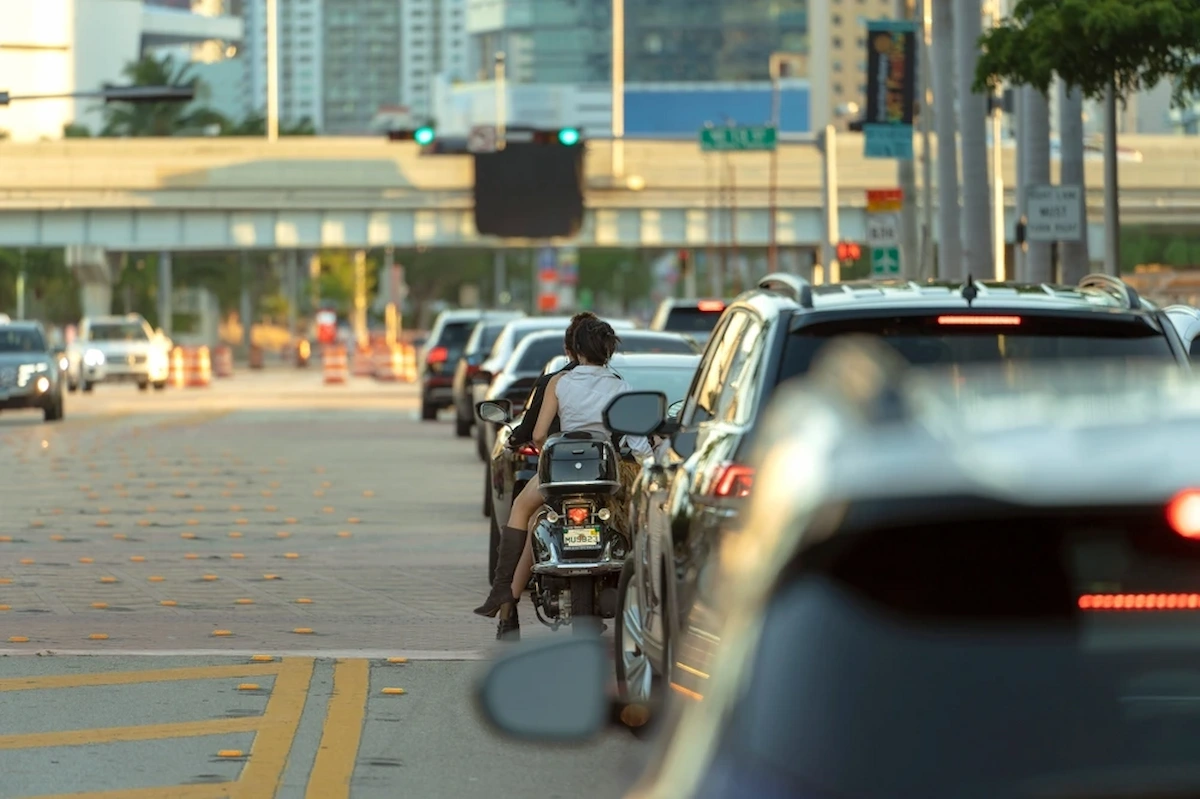
No. Texas Transportation Code Section 545.0605 expressly prohibits riding between lanes of traffic moving in the same direction and passing a motor vehicle within that vehicle's lane. It allows two motorcycles to ride abreast in one lane and exempts police officers performing official duties from the prohibitions.
If you were splitting lanes, expect the insurer to argue shared fault. That does not end the claim, because the driver's own conduct, such as an unsignaled lane change, still counts.
How Texas Divides Fault in a Motorcycle Accident Claim
Texas uses proportionate responsibility. A rider found more than 50 percent responsible cannot recover damages. If the rider is 50 percent or less responsible, the rider's damages are reduced by that percentage. On a claim with $200,000 in damages, the math looks like this:
| Rider's share of fault | Reduction | Possible recovery |
|---|
| 0% | $0 | $200,000 |
| 25% | $50,000 | $150,000 |
| 50% | $100,000 | $100,000 |
| 51% or more | Barred | $0 |
Every point of responsibility assigned to the rider can reduce recoverable damages. When several parties share blame, a defendant found more than 50 percent responsible may be jointly and severally liable for the claimant's recoverable damages, subject to applicable reductions and credits.
If an insurer has already blamed you in part, call (346) 483-2688 or start online intake to book a free consultation for a second look at the evidence.
Which Insurance Pays After a Motorcycle Crash?
Several policies can come into play.
- The at-fault driver's liability coverage. Texas minimum limits are $30,000 per injured person, $60,000 per crash, and $25,000 for property damage. A serious injury can exceed $30,000 within days.
- Uninsured and underinsured motorist (UM/UIM) coverage. Texas insurers must include UM/UIM coverage in auto liability policies unless the named insured rejects it in writing. It often matters most when the driver carries minimum limits or none.
- PIP or medical payments coverage. If your motorcycle policy includes either, it can help with medical bills while the claim is pending.
- Health insurance. Your health plan may cover treatment and later seek reimbursement from a settlement.
Compensation Available to Injured Riders
No lawyer can promise a specific result, but Texas law allows an injured rider to seek damages that can include:
- Medical expenses, past and future, including surgery, skin grafts, and rehabilitation
- Lost income and lost earning capacity
- Physical pain and mental anguish
- Physical impairment and disfigurement, including scarring from road rash
- Reasonable motorcycle and gear repair costs plus proven residual diminished value, or pre-loss value if totaled, without duplicate recovery
Exemplary damages require clear and convincing evidence of fraud, malice, or gross negligence. When a rider does not survive, Texas law allows certain family members to bring a wrongful death claim, and we handle those conversations with care and at the family's pace.
How Long Do You Have to File a Motorcycle Accident Claim in Texas?
Most injured riders have two years from the crash to file a lawsuit, and the same period generally applies to damage to the bike. Wrongful death claims run two years from the date of death, and exceptions for minors and incapacitated people can change the window.
Government claims move faster. Governmental units generally require notice of a claim within six months, and the City of Houston Legal Department requires written, notarized notice within 90 days. Waiting also costs evidence as video disappears and bikes get repaired.
How GoRo Law Handles Motorcycle Cases
GoRo Law was founded by two military veterans who later held senior in-house legal roles on the claims and disputes side. We build each motorcycle case the way an insurer's own lawyers will evaluate it, from an office at 14800 Westheimer Road near Beltway 8 and the Westpark Tollway, with phones answered 24/7.
The Attorneys on Your Case
- Edgar Gonzalez, Partner, grew up in Alief. He is a veteran U.S. Coast Guard Judge Advocate, a trial attorney who led trial teams in complex litigation, and currently serves as General Counsel & Chief Compliance Officer.
- Ben Rothchild, Partner, grew up in Katy. He is a veteran U.S. Marine Corps Judge Advocate and trial attorney who served 8 years on active duty, attained the rank of Major, and served as a prosecutor and U.S. Naval Academy professor.
- Nadia Sadeghian Gonzalez, Of Counsel, is licensed in Texas and the District of Columbia and works on injury and accident cases, as well as wills, trusts, and estates. She previously served as director of operations for an international non-profit organization.
What to Expect at Each Stage
- Free consultation. We review the crash, injuries, and insurance, and give you an honest assessment with no obligation.
- Investigation. We obtain the crash report, request preservation of video and vehicle data, document the bike before repair, and contact witnesses.
- The property claim. We pursue an appropriate total-loss valuation or repair claim, reasonable loss of use, rental, and any supported diminished value after repairs early so you are not left without transportation.
- Documenting the injury claim. We gather records as treatment continues and value the claim once the long-term picture is clear.
- Negotiation and, if needed, litigation. If the insurers will not offer fair value, we are prepared to file suit and try the case.
You hear from us at each stage, including when an offer arrives.